FONDAZIONE BRUNO KESSLER · TRENTO, ITALY

Tommaso
Campari.

Researcher at Fondazione Bruno Kessler

I am a Researcher in the Data and Knowledge Management (DKM) unit at FBK. My research focuses on open-set lifelong and social navigation in Embodied AI, with an emphasis on user-adaptive and personalized embodied agents in open-world settings.

I earned a Ph.D. in Computer Science from the University of Padova, supervised by Prof. Luciano Serafini and Prof. Lamberto Ballan, with the thesis “Embodied AI with Commonsense”. My work has appeared at CVPR, ICCV, ICLR, IJCAI and ICRA.

Tommaso Campari
Newest first
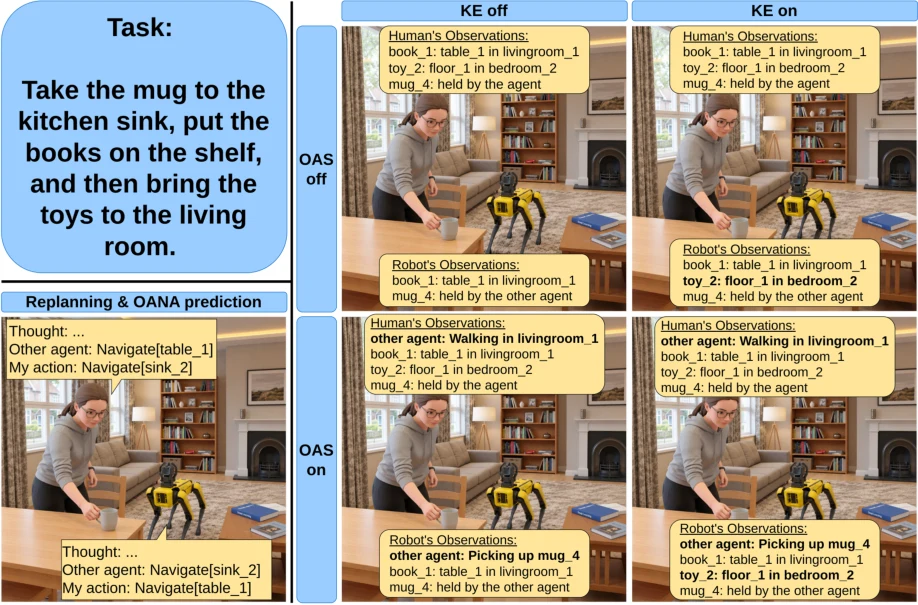
Figure from Observe, Share, or Predict? Disentangling Partner Information in Embodied Multi-Agent Collaboration
arXiv preprint arXiv:2610.168952026

Observe, Share, or Predict? Disentangling Partner Information in Embodied Multi-Agent Collaboration

Adrián Szlatincsán, Filippo Ziliotto, Bruno Lepri, Luciano Serafini, Massimiliano Luca, Tommaso Campari

Read abstract

LLMs are used as high-level controllers for embodied agents, but it remains unclear whether they support collaborative reasoning, such as anticipating a collaborator's actions in real-time teamwork without dialogue. We ask if observing the partner's state, exchanging object knowledge, and predicting the partner's next action, shape task outcomes and coordination when agents can share percepts but never intentions, plans, or task-level messages, and whether the two agents occupy symmetric roles. Using the Habitat-based PARTNR benchmark, we introduce a Decoupled Partial Observability regime that enforces strictly individual perception, and we augment decentralized zero-shot ReAct planners with Other Agent's State (OAS) observation, object Knowledge Exchange (KE) between co-located agents, and Other Agent's Next Action (OANA) prediction, evaluated on the full 2 x 2 x 2 grid with four planners on 1,000 validation tasks. OAS observation improves task quality, reducing extraneous effort for every planner, whereas KE primarily improves execution efficiency, cutting simulation steps by up to 25% with little change in success. The two are largely redundant for strong planners but complementary for the weakest, for which KE without the OAS is the worst configuration. OANA prediction lowers the success rate in 15 of 16 model x context pairs while raising explicit partner mentions to 55-100%, and its accuracy gains lie mainly in the coarse action type, partly because agents recognize the action the partner is already performing. The robot retrieves objects sooner and completes its tasks earlier than the simulated human. Shared context reduces total task time by shortening the remaining duration that the human works alone. Also, coordination benefits arise from responding to shared context, especially the OAS, rather than explicit anticipation, yielding shallow, planner-dependent partner modeling.
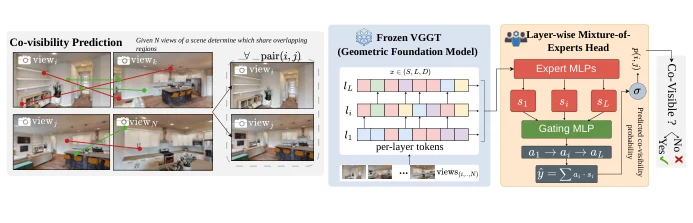
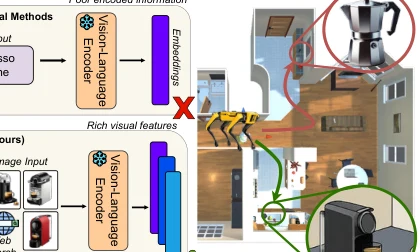
Figure from What VGGT Knows About Overlap: Probing Geometric Foundation Models for Co-visibility
European Conference on Computer Vision2026

What VGGT Knows About Overlap: Probing Geometric Foundation Models for Co-visibility

Filippo Ziliotto, Luciano Serafini, Lamberto Ballan, Tommaso Campari

Read abstract

A fundamental challenge in 3D reconstruction and robotic localization is co-visibility: determining which image pairs share overlapping visible surfaces, particularly in scenarios with minimal overlap. We demonstrate that VGGT implicitly encodes co-visibility as an emergent behavior: without any supervision for this task, its internal representations exhibit a clear hierarchical structure mirroring that of large language models, i.e. early layers build a 3D-aware scene representation, while late layers act as dedicated co-visibility reasoners. In particular, we identify layer L17 as a negative anchor that consistently routes non-co-visible pairs for this backbone, regardless of the evaluation setting, providing task-grounded evidence of layer specialization in a geometry-grounded foundation model. Building on this, we introduce Co-VGGT, which freezes VGGT and trains only a lightweight layer-wise mixture-of-experts head (less than 7.5M parameters) to classify co-visibility from RGB alone, treating each layer as a specialized expert whose geometric abstraction is adaptively weighted per input pair. On the Co-VisiON benchmark, Co-VGGT surpasses the human annotation baseline and improves over prior work by more than 25% pairwise and 10% multiview. Pairwise predictions are well-calibrated (ECE=0.030), enabling direct use as edge weights in visibility graphs for downstream SfM and SLAM pipelines without post-hoc correction. Code and data are available.

Figure from IMPRINT: Image-Conditioned Query Enrichment for Long-Tail Object Goal Navigation
arXiv preprint arXiv:2607.251062026

IMPRINT: Image-Conditioned Query Enrichment for Long-Tail Object Goal Navigation

Jelin Raphael Akkara, Filippo Ziliotto, Luciano Serafini, Lamberto Ballan, Tommaso Campari

Read abstract

Embodied AI increasingly relies on queryable semantic maps built from pre-trained vision-language models to enable zero-shot Object Goal Navigation (ObjectNav). However, existing approaches typically depend on text-only queries, which become less reliable as semantic specificity increases toward fine-grained object categories. We introduce IMPRINT, a zero-shot plug-and-play framework that enriches textual object queries with web-sourced images to improve grounding in queryable maps. Retrieved images are encoded using a vision-language model, matched against the semantic map to produce similarity maps, and aggregated to yield context-aware localization. Notably, this requires no training or modification of the underlying navigation policy. To explicitly evaluate long-tail behavior, we present HSSD-rare, a new ObjectNav benchmark built on Habitat Synthetic Scenes and featuring semantically specific subcategories. Across both OVON and HSSD-rare, image-conditioned queries consistently improve object grounding and yield end-to-end navigation gains. Further analysis reveals that translating localization gains to navigation performance depends critically on downstream detection quality, highlighting a key systems bottleneck in long-tail embodied navigation.

Figure from Personal-3D: A Comprehensive Benchmark for Personalized Embodied AI Agents
International Journal of Computer Vision2026

Personal-3D: A Comprehensive Benchmark for Personalized Embodied AI Agents

Filippo Ziliotto, Jelin Raphael Akkara, Alessandro Daniele, Lamberto Ballan, Luciano Serafini, Tommaso Campari

Read abstract

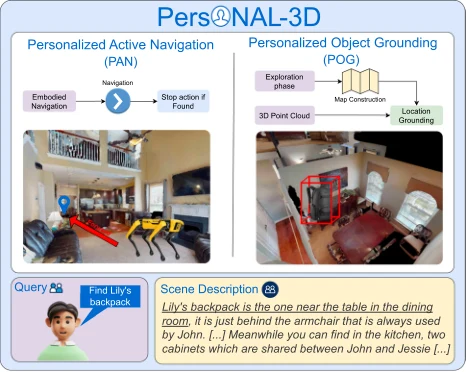
Despite significant progress in Embodied AI, current agents largely operate under generic task specifications and struggle to reason about user-specific semantics that naturally arise in human-centered environments. In domestic settings, objects are often associated with particular individuals, requiring agents to interpret personalized instructions such as ownership and preference when navigating and acting in 3D spaces. We introduce PersONAL-3D ( PERS onalized O bject N avigation A nd L ocalization), a benchmark designed to study personalized spatial reasoning in embodied environments. PersONAL-3D focuses on domestic scenarios in which an agent must navigate to target objects associated with specific individuals, given natural-language instructions such as “find Lily’s backpack” . The benchmark includes 2,000+ curated evaluation episodes across 30+ photorealistic HM3D homes. Each episode pairs a …

Figure from Personal: Towards a comprehensive benchmark for personalized embodied agents
2026 IEEE International Conference on Robotics and Automation (ICRA)2026

Personal: Towards a comprehensive benchmark for personalized embodied agents

Filippo Ziliotto, Jelin Raphael Akkara, Alessandro Daniele, Lamberto Ballan, Luciano Serafini, Tommaso Campari

Read abstract

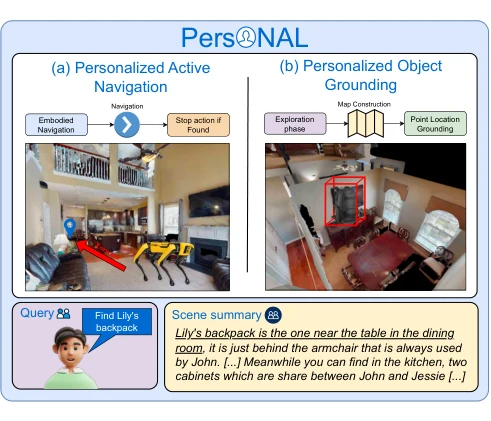
Recent advances in Embodied AI have enabled agents to perform increasingly complex tasks and adapt to diverse environments. However, deploying such agents in realistic human-centered scenarios, such as domestic households, remains challenging, particularly due to the difficulty of modeling individual human preferences and behaviors. In this work, we introduce PersONAL (PERSonalized Object Navigation And Localization, a comprehensive benchmark designed to study personalization in Embodied AI. Agents must identify, retrieve, and navigate to objects associated with specific users, responding to natural-language queries such as "find Lily's backpack". PersONAL comprises over 2,000 high-quality episodes across 30+ photorealistic homes from the HM3D dataset. Each episode includes a natural-language scene description with explicit associations between objects and their owners, requiring agents to reason over user-specific semantics. The benchmark supports two evaluation modes: (1) active navigation in unseen environments, and (2) object grounding in previously mapped scenes. Experiments with state-of-the-art baselines reveal a substantial gap to human performance, highlighting the need for embodied agents capable of perceiving, reasoning, and memorizing over personalized information; paving the way towards real-world assistive robot.

Figure from Mirror, Mirror on the Wall: Can VLM Agents Tell Who They Are at All?
arXiv preprint arXiv:2605.088162026

Mirror, Mirror on the Wall: Can VLM Agents Tell Who They Are at All?

Filippo Ziliotto, Ciro Beneduce, Bruno Lepri, Luciano Serafini, Massimiliano Luca, Tommaso Campari

Read abstract

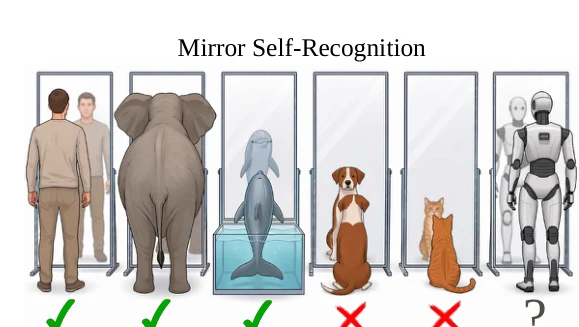
In the animal kingdom, mirror self-recognition is a canonical probe of higher-order cognition, emerging only in some species. We ask whether an analogous functional capability emerges in embodied vision-language model (VLM) agents: can they recognize themselves in a mirror? We introduce a controlled 3D benchmark where a first-person VLM agent must infer a hidden body attribute from its reflection and select the matching target, while avoiding self-other misattribution. To separate mirror-grounded self-identification from shortcuts, we test mirror removal, misleading cues, and occluded reflections. We also evaluate the decision process through mirror seeking, temporal ordering, self-attribution, and reasoning-action consistency. Our experiments show that mirror-based self-identification emerges mainly in stronger VLMs. These models can use reflected evidence for action, whereas weaker models often inspect the mirror but fail to extract self-relevant information or misattribute their reflection. Language-vision conflict further shows that self-referential language alone is not evidence of grounded self-identification. Overall, mirror-based evaluation provides a diagnostic for whether embodied self-grounding is causally rooted in perception and action rather than priors, prompt compliance, or confabulation.

Figure from LangNavBench: Evaluation of Natural Language Understanding in Semantic Navigation
arXiv e-prints2025

LangNavBench: Evaluation of Natural Language Understanding in Semantic Navigation

Sonia Raychaudhuri, Enrico Cancelli, Tommaso Campari, Lamberto Ballan, Manolis Savva, Angel X Chang

Read abstract

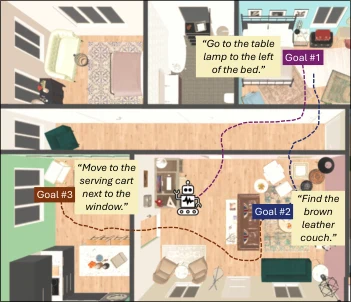
Recent progress in large vision-language models has driven improvements in language-based semantic navigation, where an embodied agent must reach a target object described in natural language. Yet we still lack a clear, language-focused evaluation framework to test how well agents ground the words in their instructions. We address this gap by proposing LangNav, an open-vocabulary multi-object navigation dataset with natural language goal descriptions (e.g. 'go to the red short candle on the table') and corresponding fine-grained linguistic annotations (e.g., attributes: color=red, size=short; relations: support=on). These labels enable systematic evaluation of language understanding. To evaluate on this setting, we extend multi-object navigation task setting to Language-guided Multi-Object Navigation (LaMoN), where the agent must find a sequence of goals specified using language. Furthermore, we propose Multi-Layered Feature Map (MLFM), a novel method that builds a queryable, multi-layered semantic map from pretrained vision-language features and proves effective for reasoning over fine-grained attributes and spatial relations in goal descriptions. Experiments on LangNav show that MLFM outperforms state-of-the-art zero-shot mapping-based navigation baselines.

Figure from Tango: training-free embodied ai agents for open-world tasks
2025 IEEE/CVF Conference on Computer Vision and Pattern Recognition (CVPR)2025

Tango: training-free embodied ai agents for open-world tasks

Filippo Ziliotto, Tommaso Campari, Luciano Serafini, Lamberto Ballan

Read abstract

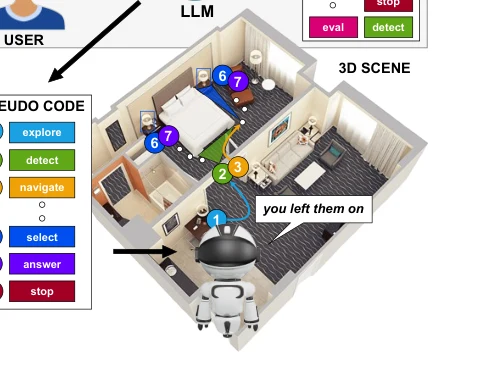
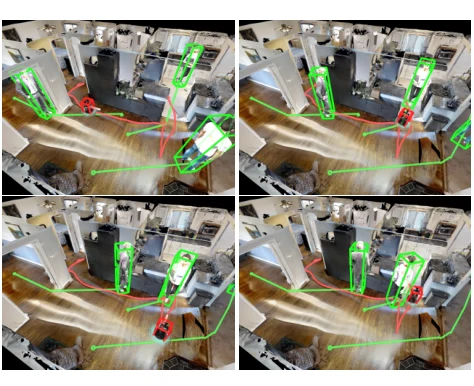
Large Language Models (LLMs) have demonstrated excellent capabilities in composing various modules together to create programs that can perform complex reasoning tasks on images. In this paper, we propose TANGO, an approach that extends the program composition via LLMs already observed for images, aiming to integrate those capabilities into embodied agents capable of observing and acting in the world. Specifically, by employing a simple PointGoal Navigation model combined with a memory-based exploration policy as a foundational primitive for guiding an agent through the world, we show how a single model can address diverse tasks without additional training. We task an LLM with composing the provided primitives to solve a specific task, using only a few in-context examples in the prompt. We evaluate our approach on three key Embodied AI tasks: Open-Set ObjectGoal Navigation, Multi-Modal Lifelong Navigation, and Open Embodied Question Answering, achieving state-of-the-art results without any specific fine-tuning in challenging zero-shot scenarios.

Figure from Following the human thread in social navigation
ICLR (Spotlight)2025

Following the human thread in social navigation

Luca Scofano, Alessio Sampieri, Tommaso Campari, Valentino Sacco, Indro Spinelli, Lamberto Ballan, Fabio Galasso

Read abstract

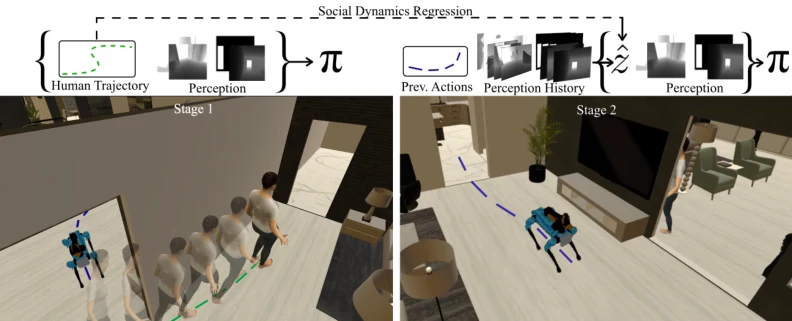
The success of collaboration between humans and robots in shared environments relies on the robot's real-time adaptation to human motion. Specifically, in Social Navigation, the agent should be close enough to assist but ready to back up to let the human move freely, avoiding collisions. Human trajectories emerge as crucial cues in Social Navigation, but they are partially observable from the robot's egocentric view and computationally complex to process. We present the first Social Dynamics Adaptation model (SDA) based on the robot's state-action history to infer the social dynamics. We propose a two-stage Reinforcement Learning framework: the first learns to encode the human trajectories into social dynamics and learns a motion policy conditioned on this encoded information, the current status, and the previous action. Here, the trajectories are fully visible, ie, assumed as privileged information. In the second stage, the trained policy operates without direct access to trajectories. Instead, the model infers the social dynamics solely from the history of previous actions and statuses in real-time. Tested on the novel Habitat 3.0 platform, SDA sets a novel state-of-the-art (SotA) performance in finding and following humans. The code can be found at https://github. com/L-Scofano/SDA.

Figure from Simple and effective transfer learning for neuro-symbolic integration
International Conference on Neural-Symbolic Learning and Reasoning2024

Simple and effective transfer learning for neuro-symbolic integration

Alessandro Daniele, Tommaso Campari, Sagar Malhotra, Luciano Serafini

Read abstract

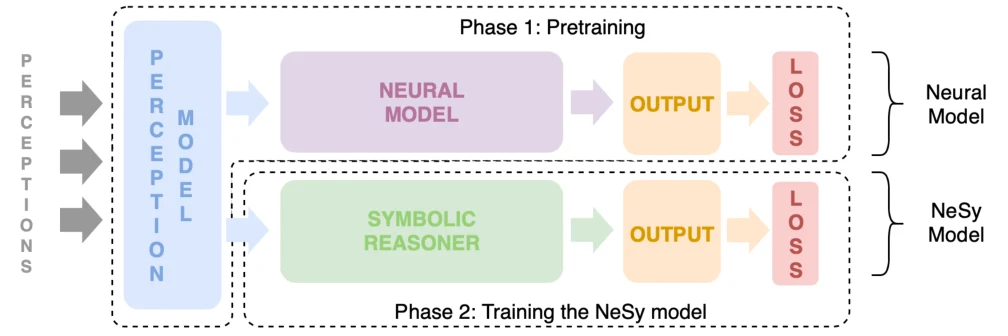
Deep Learning (DL) techniques have achieved remarkable successes in recent years. However, their ability to generalize and execute reasoning tasks remains a challenge. A potential solution to this issue is Neuro-Symbolic Integration (NeSy), where neural approaches are combined with symbolic reasoning. Most of these methods exploit a neural network to map perceptions to symbols and a logical reasoner to predict the output of the downstream task. These methods exhibit superior generalization capacity compared to fully neural architectures. However, they suffer from several issues, including slow convergence, learning difficulties with complex perception tasks, and convergence to local minima. This paper proposes a simple yet effective method to ameliorate these problems. The key idea involves pretraining a neural model on the downstream task. Then, a NeSy model is trained on the same task via transfer learning, where the weights of the perceptual part are injected from the pretrained network. The key observation of our work is that the neural network fails to generalize only at the level of the symbolic part while being perfectly capable of learning the mapping from perceptions to symbols. We have tested our training strategy on various SOTA NeSy methods and datasets, demonstrating consistent improvements in the aforementioned problems.

Figure from Mopa: Modular object navigation with pointgoal agents
2024 IEEE/CVF Winter Conference on Applications of Computer Vision (WACV)2024

Mopa: Modular object navigation with pointgoal agents

Sonia Raychaudhuri, Tommaso Campari, Unnat Jain, Manolis Savva, Angel X Chang

Read abstract

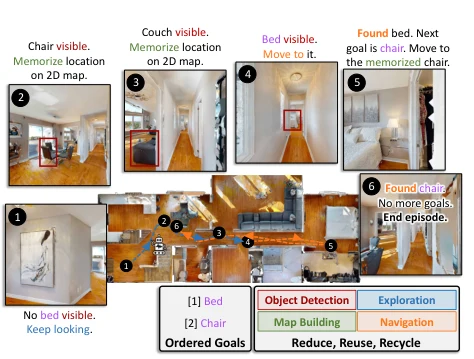
We propose a simple but effective modular approach MOPA (Modular ObjectNav with PointGoal agents) to systematically investigate the inherent modularity of the object navigation task in Embodied AI. MOPA consists of four modules: (a) an object detection module trained to identify objects from RGB images, (b) a map building module to build a semantic map of the observed objects, (c) an exploration module enabling the agent to explore the environment, and (d) a navigation module to move to identified target objects. We show that we can effectively reuse a pretrained PointGoal agent as the navigation model instead of learning to navigate from scratch, thus saving time and compute. We also compare various exploration strategies for MOPA and find that a simple uniform strategy significantly outperforms more advanced exploration methods.

Figure from Exploiting proximity-aware tasks for embodied social navigation
2023 IEEE/CVF International Conference on Computer Vision (ICCV)2023

Exploiting proximity-aware tasks for embodied social navigation

Enrico Cancelli, Tommaso Campari, Luciano Serafini, Angel X Chang, Lamberto Ballan

Read abstract

Learning how to navigate among humans in an occluded and spatially constrained indoor environment, is a key ability required to embodied agent to be integrated into our society. In this paper, we propose an end-to-end architecture that exploits Proximity-Aware Tasks (referred as to Risk and Proximity Compass) to inject into a reinforcement learning navigation policy the ability to infer common-sense social behaviors. To this end, our tasks exploit the notion of immediate and future dangers of collision. Furthermore, we propose an evaluation protocol specifically designed for the Social Navigation Task in simulated environments. This is done to capture fine-grained features and characteristics of the policy by analyzing the minimal unit of human-robot spatial interaction, called Encounter. We validate our approach on Gibson4+ and Habitat-Matterport3D datasets.

Figure from Deep symbolic learning: Discovering symbols and rules from perceptions
International Joint Conference of Artificial Intelligence, IJCAI-232023

Deep symbolic learning: Discovering symbols and rules from perceptions

Alessandro Daniele, Tommaso Campari, Sagar Malhotra, Luciano Serafini

Read abstract

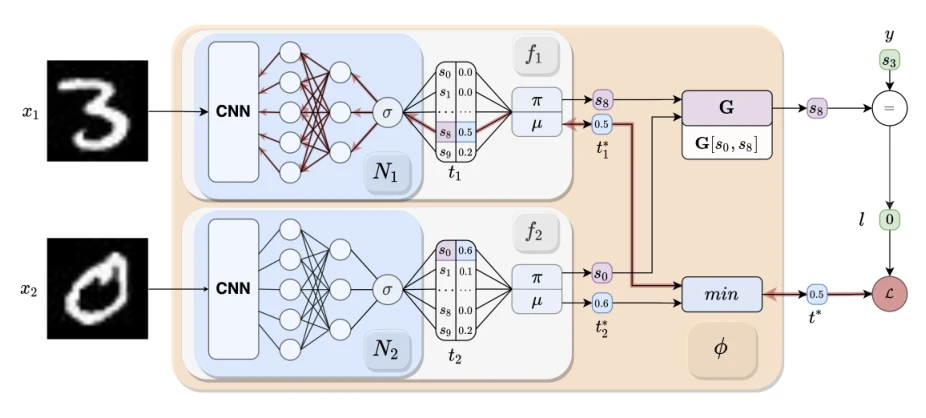
Neuro-Symbolic (NeSy) integration combines symbolic reasoning with Neural Networks (NNs) for tasks requiring perception and reasoning. Most NeSy systems rely on continuous relaxation of logical knowledge, and no discrete decisions are made within the model pipeline. Furthermore, these methods assume that the symbolic rules are given. In this paper, we propose Deep Symbolic Learning (DSL), a NeSy system that learns NeSy-functions, i.e., the composition of a (set of) perception functions which map continuous data to discrete symbols, and a symbolic function over the set of symbols. DSL learns simultaneously the perception and symbolic functions while being trained only on their composition (NeSy-function). The key novelty of DSL is that it can create internal (interpretable) symbolic representations and map them to perception inputs within a differentiable NN learning pipeline. The created symbols are automatically selected to generate symbolic functions that best explain the data. We provide experimental analysis to substantiate the efficacy of DSL in simultaneously learning perception and symbolic functions.

Publication ↗
Università degli studi di Padova , 20232023

Embodied AI with Common-Sense

Tommaso Campari

Read abstract

Embodied AI, or artificial intelligence that is integrated into physical bodies, is an increasingly important area of research due to its potential for creating intelligent agents that can interact with and learn from the real world. These embodied agents can assist humans in a variety of tasks, such as manufacturing, healthcare, and search and rescue operations. For example, industrial robots can be equipped with artificial intelligence to assist in assembly line tasks, allowing for more efficient and accurate production. In healthcare, robots can be used to deliver medication and assist with rehabilitation exercises. In search and rescue operations, robots can be deployed to dangerous or difficult-to-reach areas to gather information and provide assistance. This thesis presents several contributions to the field of Embodied AI, addressing four research questions:(1) how can an agent exploit common-sense knowledge about the environment,(2) how can an agent reuse previously acquired knowledge about a specific environment,(3) how can an agent comply with social rules, and (4) how can an agent acquire knowledge and common-sense rules. To address these research questions, the thesis presents a number of works that provide possible solutions. For example, one work developed a model in which a shared embedding is injected into a Scene-Memory Transformer to improve the ability of an agent to exploit common-sense knowledge about the environment. Another work defined a modular architecture for the Object Goal Navigation task that allows an agent to reuse previously acquired knowledge about a specific environment. Another work …

Figure from Retrospectives on the embodied ai workshop
arXiv preprint arXiv:2210.068492022

Retrospectives on the embodied ai workshop

Matt Deitke, Dhruv Batra, Yonatan Bisk, Tommaso Campari, Angel X Chang, Devendra Singh Chaplot, Changan Chen, Claudia Pérez D'Arpino, Kiana Ehsani, Ali Farhadi, Li Fei-Fei, Anthony Francis, Chuang Gan, Kristen Grauman, David Hall, Winson Han, Unnat Jain, Aniruddha Kembhavi, Jacob Krantz, Stefan Lee, Chengshu Li, Sagnik Majumder, Oleksandr Maksymets, Roberto Martín-Martín, Roozbeh Mottaghi, Sonia Raychaudhuri, Mike Roberts, Silvio Savarese, Manolis Savva, Mohit Shridhar, Niko Sünderhauf, Andrew Szot, Ben Talbot, Joshua B Tenenbaum, Jesse Thomason, Alexander Toshev, Joanne Truong, Luca Weihs, Jiajun Wu

Read abstract

We present a retrospective on the state of Embodied AI research. Our analysis focuses on 13 challenges presented at the Embodied AI Workshop at CVPR. These challenges are grouped into three themes: (1) visual navigation, (2) rearrangement, and (3) embodied vision-and-language. We discuss the dominant datasets within each theme, evaluation metrics for the challenges, and the performance of state-of-the-art models. We highlight commonalities between top approaches to the challenges and identify potential future directions for Embodied AI research.

Figure from Online learning of reusable abstract models for object goal navigation
2022 IEEE/CVF Conference on Computer Vision and Pattern Recognition (CVPR)2022

Online learning of reusable abstract models for object goal navigation

Tommaso Campari, Leonardo Lamanna, Paolo Traverso, Luciano Serafini, Lamberto Ballan

Read abstract

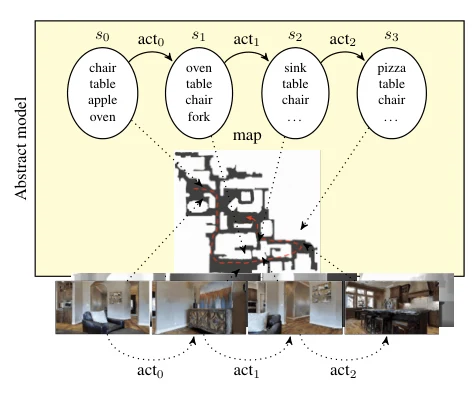
In this paper, we present a novel approach to incrementally learn an Abstract Model of an unknown environment, and show how an agent can reuse the learned model for tackling the Object Goal Navigation task. The Abstract Model is a finite state machine in which each state is an abstraction of a state of the environment, as perceived by the agent in a certain position and orientation. The perceptions are high-dimensional sensory data (e.g., RGB-D images), and the abstraction is reached by exploiting image segmentation and the Taskonomy model bank. The learning of the Abstract Model is accomplished by executing actions, observing the reached state, and updating the Abstract Model with the acquired information. The learned models are memorized by the agent, and they are reused whenever it recognizes to be in an environment that corresponds to the stored model. We investigate the effectiveness of the proposed approach for the Object Goal Navigation task, relying on public benchmarks. Our results show that the reuse of learned Abstract Models can boost performance on Object Goal Navigation.

Figure from Exploiting scene-specific features for object goal navigation
European Conference on Computer Vision2020

Exploiting scene-specific features for object goal navigation

Tommaso Campari, Paolo Eccher, Luciano Serafini, Lamberto Ballan

Read abstract

Can the intrinsic relation between an object and the room in which it is usually located help agents in the Visual Navigation Task? We study this question in the context of Object Navigation, a problem in which an agent has to reach an object of a specific class while moving in a complex domestic environment. In this paper, we introduce a new reduced dataset that speeds up the training of navigation models, a notoriously complex task. Our proposed dataset permits the training of models that do not exploit online-built maps in reasonable times even without the use of huge computational resources. Therefore, this reduced dataset guarantees a significant benchmark and it can be used to identify promising models that could be then tried on bigger and more challenging datasets. Subsequently, we propose the SMTSC model, an attention-based model capable of exploiting the correlation between scenes and objects contained in them, highlighting quantitatively how the idea is correct.

News

Contact